The Illinois Virtual High School (IVHS) is a state entity
that provides online distance learning to students whom are registered within
II. How
IVHS Could Benefit the Educational
Process
Whether
or not one is dealing with a rich or poor, large or small, technologically
savvy staff or not, or specifically a certain high school or some other school,
there are a number of beneficial reasons why online distance education is a
necessary ingredient for learning within a school. There are benefits for
students, teachers and an entire district.
Research
shows students benefit from learning experiences that make use of important
learning considerations. The following two considerations are obtainable via
online distance education: exposure to 1) multiple types of learning
interactions, and 2) instructional media. These considerations will be
explained.
There
are three types of learning interactions. There are learner-content and
learner-instructor. There is also learner-learner.
The
research regarding learner interaction diverges. According to
It
is clear that distance education research is in its fledgling state and that
the assumptions and parameters of its studies must themselves be investigated.
Until such research is conducted, one must assume the learner-learner
interaction must not be overlooked. This would imply all three interactions
bear value.
In
addition to learner interactions, educators must also consider the value of instructional
media. Learning tools that are accessible via computers and the Internet hold
great value to the learning process. Instructional media tools can be used to
minimize fatigue, integrate visuals and text, display advance organizers, and
offer introductory problems. It can also provide memory support, worked
examples, practice exercises, graphics, and evaluate learners against standards
(Karadimos, 2004).
Online
distance education is able to balance the three learning interactions and make
use of instructional media tools. Through online distance education,
instructors have the ability to balance the three learning interactions by
building appropriate structures by design and by adjusting learners’
performances unit by unit – typically week by week. Instructors can also build
courses around specific learning tools and/or point learners to online content
that uses instructional media elements.
Teachers
benefit from participating within online distance education for a number of
reasons. They will benefit due to the following traits (Florida Center for Instructional Technology, 1999: Chapter 2):
- Convenience – teachers would be able to perform their
duties from their homes, libraries, and technology centers.
- Flexibility – teachers would be able to grade papers,
make comments to students, and refine curriculum at any time during the
day.
- Effectiveness – online distance education has been
proven to work.
- Multi-sensory – the nature of distance education allows
teachers to use a myriad of tools to assist the transport of information
and skills by matching students with their learning preferences.
- Interactivity – distance learning allows shy learners
the ability to make contributions and it prevents a person from dominating
discussions.
- Equity – distance education allows high quality
teachers to reach students: (a) who reside in rural areas, and (b)
students who are physically challenged.
It
can be seen that these traits benefit students as well as teachers. These facts
must then naturally drive effective teachers to accept distance education. Such
a view could be used to modify the culture of a school through these exemplary
teachers.
C. How
the District Would Benefit
There
is another list of advantages that distance education offers. This list applies
to schools and districts (Florida Center for
Instructional Technology, 1999: Chapter 3):
- Instruction
for Homebound Students – students who cannot attend school need not lose
instructional time. Students can either communicate with teachers via
Internet technologies or they could be placed within a distance learning
courses.
- Virtual High Schools – students who are unable to
access education because they are jailed, expelled from attending school,
or are unable to attend a certain class can benefit from courses offered
through distance learning schools. Students could access asynchronous
learning within online distance education.
- Instruction for Distributed Classes – courses can be
formed for students even though student numbers may be low at individual
schools. Using a collectivist system, pulling students from multiple
schools, classes could be filled. This would allow schools to provide
service to more students, allowing more communities to prosper.
- Interactions with Outside Experts – distance education
technologies make it easier to incorporate outsiders to education.
- Collaborative Projects – students from many schools can
be pulled together to form project teams that reach issues involving the
environment, various communities, or some other data gathering activity.
- Access to Remote Resources – Websites offer
comprehensive information (text, video, webcams, …) that allow students to
easily study locations outside their school districts, states, and
countries.
- Staff Development Programs – teachers can undertake
training programs using an online environment, regardless of the size or
location of the teaching staff in a school.
Again, it is evident this list reflects benefits to
districts, teachers and students. Where one benefits, it is common that others
benefit, too. This provides evidence of mutual benefits for an entire
organization.
III. Reviewing the Planning Process
The
A. Needs Assessment
This
step involves determining the content areas that could be enhanced, expanded,
or initiated. This means concentrating on the school's interests and strengths.
At a course level, due to the school's large Latino population, there may be
great interest in dealing with Latin studies courses.
Possible
target populations to consider would be homebound students, expelled students,
or students who have been removed from classes. To consider instructors, it
must be determined how it is that such a role is handled, including determining
interest (buy-in), instructional teams, and content creation possibilities.
It
is also necessary to determine technology needs. Since
B. Outline Instructional
Goals and Objectives; Produce Instructional Materials
It
is important to first achieve a culture where vision and goals are shared by
those who are acting leaders (Kaester, 2005). Once
goals are determined, it is then possible to develop instructional materials.
Therefore, the planning process is an important one that involves the creation
of a well thought pedagogical skeleton to which the coming instruction systems
will be placed. It is expected the technology to be seamless and of no special
concern to the learner.
C.
Provide Training and Practice for Instructors and Facilitators
Instructors
have to be cognizant of a number of important considerations when dealing with
online distance education content. Instructors have to be aware of strategies
that invite learner-content, learner-instructor, and learner-learner
interaction. They have to know how to motivate distance learners, which may
require knowing about learners through an interest survey. Instructors must
also need to know the usefulness of instructional media and how to integrate
such devices into the curriculum.
The role of
the instructor need not be the same as a course designer, at first. Instructors
may initially operate as assistants to student learning and exist as mentors.
Once the process is refined, instructors then could be placed into design teams
to create their own course content.
It is
suggested that the program include a long test process to ensure all areas of
design and manpower have been effectively handled. The process of
implementation requires attentiveness to timelines and firm deadlines. To
successfully handle the implementation process, there has to be on-going
evaluation throughout the entire process – previous steps included – and open
communication between all participants.
IV. Planning Concerns
The
act of planning consists of at least forty-four challenges as outlined by
Horizon (2006). The concerns are separated into three groups: instruction,
management, and assessment. Each of these concerns will be investigated below.
The three groups will also be accompanied by another important consideration:
Traditional
education is much different than online distance education. Consequently, the
concerns are different. Online distance learners work with computers to access
the educational materials. Instructors must create a learning environment that
is challenging and learner-centered. Instructors have to be ready to create
mechanisms that take in to account varied learning styles and how instructional
media can be effectively used. [See Table 2: Instructional Challenges for a comprehensive list of guiding
questions.]
Since
online distance learning varies differently than traditional, face-to-face,
learning, there are a number of challenges that management must face. There are
issues that cover the following as they relate to distance education:
teacher-preparedness and training, goals, developing a cost/benefit analysis,
and teaming. Administrators must also foresee workloads, incentive programs,
and an assessment program. [Table 3: Management
Challenges contains a list of questions to assist in the management
process.]
Administration
with instructors must determine a method for assessing the effectiveness of an
online distance program. The effectiveness of the program should measure the
three learning interactions and the ability to create a seamless technology
platform. Surveys could be used to measure the satisfaction of learners and
teachers. Educational standards and qualifiers could also be developed so as to
compare distance learning with traditional learning. [For a list of questions
that pertain to the challenges of assessment, see Table 4.]
V.
Distance Learning Technologies
Part
of the planning process must involve careful consideration to technology. Which
technologies will be used? How instructors, students, and the technology team
are prepared in dealing with them is another concern.
There
are technologies unique to online distance learning. The broader area of
distance education invites the use of mail, audioconference,
telecourse, videoconference, and print. There is also
webcast and webconference (
Mail – communication occurs via mail
correspondence.
Audioconference – real-time communication takes place
via phone or audio.
Videoconference – image broadcasting
and receiving mechanisms allow for real-time communication.
Telecourse – DVD, VHS, or broadcasted media
allow learning through this type of programming.
Print – textbooks, manual, articles,
and other written materials that allow for learning.
Webcast – this is learning via
audio, video or slide productions through the Internet.
Webconference – real-rime
video and audio communication via the Internet.
Online – computer management
software allow learning via the Internet. There are a number of providers for
online learning, such as WebCT, eCollege,
D2L, Blackboard, and more.
Distance
learning, including online distance learning, typically incorporates numerous
technologies. It is common for online distance education providers to use an
online management system, print, webcast, and videoconferencing. By using
multiple technologies, the education becomes learner-centered and sensitive to
their learning styles.
It
is possible to reinvent the wheel for an organization. However, existing
virtual schools make this step of the process relatively easy. The virtual
schools already provide the online course management portion, which will be
discussed in the next section.
The
next step involves determining which supplementary materials are necessary for
running specific courses. An instructor or instructional team will have to
decide which supplementary materials are best for their courses. Print is a
staple for each course, but other media must be chosen to be sensitive to
learning styles.
A
logical step for most schools at the high school level will be to locate an
existing distance education provider. This eliminates numerous technology
issues, because the granting distance education body already has a time-tested
program that is up and running.
IVHS,
for example, uses eCollege (2006). The system that eCollege offers includes a gradebook,
document sharing, and search capabilities. It also includes an ability to
e-mail other learners in a course, document sharing, a journal, and a helpful webliography.
Once
online course management software has been obtained, supplementary materials
will have to be obtained. Relevant books and articles and print materials will
be ordered. Software tools to generate audio, visual, graphic organizers and
other devices may have to be purchased. To determine the tools that are
necessary to form an effective program, it is suggested that research be done
to determine which tools are obtainable and reasonable choices.
There
will be a need to conduct two different types of training programs. There will
be a need to familiarize students with the technology. Teachers will also have
to be trained to work with technology.
Student
training can take place in many forms. Students can be trained by an initial
face-to-face program. A trainer could actually take students through the course
management system and show how everything works. Another way to instruct
learners would be to have learners go through a self-guided program, as is
offered by some institutions (Capella, 2006).
The
provider of the course management system should be able to inform instructors
how to use the system. Instructors will have to learn how to place unit goals,
instructional media, and other content on these systems. The provider can train
the instructors or, in the case of eCollege (2005),
course designers can relay their intentions to eCollege
staff who can in turn create the final product.
Schools
already have technologists on staff to handle computer-related issues. These
people can be used to make the process of running and maintaining online
learning environments, too. Since it is likely that such a team will only serve
to provide a seamless operation by maintaining communication with online
educators and students, their duties need not be significantly altered.
Even though
The Florida Center for Instructional Technology does not call for a pilot group
in its process, such a consideration is worthy of investigation. A pilot
program would force the guiding teams to monitor and adjust processes. Doing as
such before allowing online distance education to be offered to the entire
population may be necessary for fine-tuning the process and avoiding potential
pitfalls.
Such a
pilot program would allow instructors, learners, administrators, and the
technology team to work through the forty-four challenges (Horizon, 2006).
Consequently, this stage is crucial for making a viable, long-lasting program.
In
order to start an online distance education program, there is a considerable
amount of planning involved. An organization has to consider numerous factors
to determine a list of acceptable courses to offer to a population. In an
effort to monitor learners through their courses, an effective instructional
management system has to be established. Those two facets of the online
distance learning development process are the topics to be addressed below.
A.
Developing a List of Acceptable Courses
Developing
a list of acceptable courses for learners requires educators to reflect on the
strengths and interests of an institution’s learning and teaching population. The
school is approximately 95% Hispanic (IES, 2004). This would suggest courses
such as Latin-American History, Spanish, Mexican Art, and Mexican Dance may
fair best in an online distance education system that students would like to
enroll. Or, because numeracy and literacy are important considerations to
acknowledge (see part X, sections A and B by the same titles), English, math
and other academic courses may pose a greater priority.
However,
there may be educators who would one-day like to make contributions to virtual
education. They may like to create their own courses, some of which may stray
from the above list of courses. These educators may hold particular knowledge
or ability that would make these courses valuable to an online learning community.
These interests would have to be taken in to account when such a staff is ready
to create and instruct their own courses.
B.
Monitoring Student Progress
Once
instructional concerns are addressed, there is a strong need to address student
progress. Doing so requires building a learning structure that also reflects
the needs of a learning population. The three models below will represent ideas
for meeting the needs of a high school’s learning population in an effort to
provide a safety net for learners.
1.
The
mentor model is one that places students in close contact with an educator,
possibly in a computer laboratory setting. The educator could be the course
instructor, but the educator could be an aid whom is knowledgeable with the
course management system. This educator would have to know how to access online
information via search engines and be able to indicate which sources were of
value.
A
mentor model could be used for many other purposes. A mentor could be used for
students to demonstrate their abilities within the framework of authentic
assessment exercises designed by the instructor. Mentors could provide
meaningful feedback on course projects. A mentor could also be used to manage
student project teams.
Within
a coordinator model, students would be monitored by an educator. This educator
may provide information related to course tasks, but need not do so in a
face-to-face fashion. This model would place learners in intermediate contact
with an educator. The educator could check in with students at the beginning,
middle, and end of a course. The instructor could contact the coordinator if
the learner manifests a learning problem.
This
model is the model that is standard with most online distance learning
programs. This model often times offers no direct assistance, save for phone
numbers and e-mail address of technical staff and an instructor. This model can
be used if there are certain assumptions that are valid. These assumptions are:
a. Learners are knowledgeable with
computer use and software
b. Technology is seamless and
time-tested
c. Learners are independent
As
it can be seen, the three models exist on a spectrum. On one extreme, students
are closely monitored as they progress through a course. On the other extreme,
there is no special monitoring for online learners, save for the instructor.
Choosing a model, like many of the other options within this developmental
process, depends upon the characteristics of the learners who will use the
system. This makes each model hold merit for certain types of schools.
When
considering the school, it would appear that the mentor model or the
coordinator model would be the best models. If students have no experience with
computer use or have limited online access where they dwell, the mentor model
would be preferred over the coordinator model.
VIII.
Developing Courses for IVHS
After
the initial phase of running through a number of cycles is complete and students
have had an opportunity to take online distance education courses, the faculty
may consider building its own online distance education courses. The luxury of
having run through online courses will enable the administration to consider a
number of factors, such as student and faculty needs, technology issues, and
management indicators. To address these concerns, the school will have to form
teams, determine a process for course creation, and determine a process for
course modification.
There
are three distinct areas for team-building. Technology, instruction, and
management teams must be created to handle the online distance education
demands that will naturally materialize. The paragraphs that follow will focus
on personnel to include a need for goals and open communication.
Technology
specialists will be called upon to investigate, install, and monitor software
and hardware devices. Instructors will have to rely upon the knowledge of
technologists to investigate the available software tools that can be used to
create organizational aids, audio and video tools, and other media (
The
process of investigation includes a need to communicate information to other
teams. Technologists have to learn which products are most needed and
affordable, which requires the team to speak with instructors. Technologists
can question instructors to learn if there are software preferences and can
then determine which of those preferences lead to affordable choices.
The
technology team will also have to instruct teachers of online courses. Besides
teaching them how to use course construction items, like audio, video, and
still-picture media, they will also have to show instructors how to use the
full functionality of the courseware product being used for online distance
education.
It
can be seen this team has to perform many important duties that require many
talents. Therefore, the team will have to consist of individuals who are
knowledgeable and able to communicate their knowledge. A willingness to create
an online distance education program would also be an added benefit.
Due
to the many demands that would be placed on such a team, it is suggested
current technologists who run the school's informational systems must not be
the default technology team. Team members can be pulled from faculty who are
already familiar with online distance education or technology used to create
online distance education products. These potential members could be found by
the use of a faculty survey.
Instructors
who would teach online students would have to perform many tasks. Instructors
would have to learn how to develop online distance education curricula. They
would have to find and create supplemental materials, too.
Table
2: Instructional Challenges outlines
a number of concerns that instructors have to face when creating and dealing
with online distance education courses. These concerns cover a number of
important areas that requires intimate knowledge of the school's technology
capabilities. It would also be beneficial to instructors if they had knowledge
of various characteristics of its students.
The
knowledge base necessary for building an effective program is such that it
would be helpful for instructors to have gone through an online distance
education course or at least receive a training program. Since
The
management team would be faced with a multitude of duties. Coordinating efforts
between the technology and instructor teams would involve a systems approach.
This would include setting up goals, instituting a timeline, and communicating
with teams. It would also require great reflection on items mentioned in Table
3: Management Challenges.
The
management team would have to determine the goals of the distance education
program. The goals of the program would likely be dependant
upon the following factors: costs, budget allowance, and faculty involvement.
Student involvement and success of a pilot program would be two other factors
that would weigh heavily on goals.
A
timeline would drive the pace. This makes the accuracy of the timeline dependant upon the management team’s ability to communicate
with other teams. The better the communication, the better the timeline as it
applies to its ability to drive the development of the online program toward
realistic progress.
The
management team, like the technology team, need not be one entirely consisting
of administrators. Since the school's history is rich with faculty involvement
within committees, a team consisting of administration and faculty would best
suit the development of an online program. Such a model would automatically
build in communication to the system. A default team of administrators would
not be necessary to create and respond to critical indicators (see section C: Determine Process for Course Modification
and part IX, section A: Determine
Critical Indicators).
B.
Determine Process for Course Creation
To
determine a process for course, it would have to be known which courses would
best be created. This means understanding the knowledge base of instructors and
the willingness of those instructors to create online courses. Also, the
learning population’s demand for certain classes would be another
consideration.
To
determine these considerations, a survey would need to be carefully drafted and
executed. The survey would have to ask respondents to list their willingness to
teach online courses and their knowledge concerning courses. A 5-point Likert scale (Trochim, 2002)
could be used to rate the replies.
C.
Determine Process for Course Modification
There
comes a time within the life of a course to modify it. Course modification can
be based on numerous items that include changes in the following: learner
population, state standards, and technology. Other items include changes in
instructional staff, budget, and course emphasis.
Changes
in many of the aforementioned items are not foreseeable. As learning
institutions change, the curriculum in combination with other aspects of the
institution also changes. However, critical indicators can be used to determine
a need to modify courses. Critical indicators will be discussed in part IX,
section A: Determine Critical Indicators.
The
process for modifying change is one that is also not foreseeable. Either an
existing committee, such as the School Improvement Planning Committee could be
used or a special online distance learning committee could be formed. In either
case, such a committee would analyze changes that occur at the school and within the critical indicator data set.
The
school is a traditional school. It may already implore a number of dynamic
strategies, such as writing projects, cooperative learning strategies, and
technology integration programs; but, it does not yet utilize distance
education. Creating a distance education program would require it to be a
hybrid institution.
There
are two ways for instituting distance education in a hybrid fashion at the
school. One way would be to allow IVHS to handle all courseroom
related items. Another way would be to have the school house all courseroom related items on its own server.
There
are benefits and disadvantages to both possibilities. If IVHS were serve the
courses on its servers, then it would be responsible for a majority of the
technology issues; but the school's educators would lose curricular autonomy.
The opposite would be true if the school ran its courses on its own servers.
The
largest area of concern could be jobs. There are faculty members who could
become concerned that an online distance education program could jeopardize the
existing number of jobs. This concern is important. Addressing it incorrectly
could run a risk of affecting faculty interest and the final success of an
online distance education program.
It
must be known to all faculty members that building an online program will not
run a risk of costing anyone a teaching position. To guarantee no loss of
positions, limitations on the types of courses could be instituted. Online
courses could be limited to homebound, night school, and summer school
students.
Courses
could also be made available in such a way as to pull from teachers who retire.
Retiring teachers need not be replaced in the traditional sense. Instead, a
distance education instructor could be used to offer some of the courses the
retiring teacher used to teach. Another option would be to have the
administration insist that no one will lose a position
with School Board approval.
As part of
the online distance education program, like all other educational programs, it
needs to be evaluated. School Board officials and educational leaders must
determine which factors to determine and monitor for the purpose of evaluation.
The next three sections will address this area.
A. Determine Critical Indicators
Like
every educational program, online distance education must invite analysis.
Analysis of performance indicators helps educators adjust programs and
activities to ensure quality. Possible performance indicators can include but
are not limited to learner completion rates, grades, and achievement. There is
also learner and instructor satisfaction to consider.
The
management team would have to determine a set of indicators to study. This list
could be small and consider only a few factors. The list could be inclusive and
study all factors. The number of indicators should be determined by the
management team in conjunction with other teams, the faculty, and the Board of
Education.
To
benefit from an analysis of indicators, sampling needs to be done on an
on-going basis. Surveys could be used at numerous stages to gain feedback
regarding learner and instructor satisfaction. Grades, completion rates, and course
interaction could easily be gained from the capabilities of courseroom
software.
Determining
indicators and monitoring data based on the indicators is the beginning of the
improvement process. The remainder and most challenging part of the process is
adjusting the distance learning based upon the indicators, which will be
addressed within the next section.
C.
Adjust IVHS Activities Based Upon Indicators
Adjusting
online distance learning is the next step of the process. This process must
involve a committee. The committee could be the management team or the existing
School Improvement Planning Committee. Whichever team is used, the optimum team
will be the team that is comprised of online instructors, traditional
instructors, technologists, and administrators who already have involvement
with the online learning.
Requiring
a team to be comprised as defined above would allow for numerous advantages.
The advantages include an ability to relay information, participants would have
a stake in the process, and the change process could take place in a timely
manner. To facilitate the operation of such a committee, the committee should
require Robert’s Rules of Order (Robert's Rules Association, 2000), which
offers a set of procedures for handling committees.
X. IVHS
and Student Achievement on Standardized Tests
The
school is located near
Consequently,
numeracy and literacy have become the curricular focus for the school. If
online distance learning is to provide a legitimate direction for the school to
follow, it stands to reason that such a program should address literacy and
numeracy concerns. The next two sections will explain how online distance
learning can improve literacy and numeracy.
The
Association of College Research and Libraries (2003) has made available a
number of characteristics of programs that reflect best practices for literacy
programs. Table 6: Literacy Guidelines reflects those characteristics.
Many of the characteristics have been previously addressed in this paper, like
the need for collaboration, consistency, and assessment strategies that invite
the educational community to achieve a state of constant improvement. Tables 2,
3, and 4 invite such an educational state.
The National Council for the
Teachers of Mathematics (2006) has outlined a number of principles for creating
the proper foundations for mathematics education. The outline includes six
principles. They include equity, curriculum, teaching, learning, assessment,
and technology.
Each principle can be addressed via
online distance education. The principles call for high expectations, coherent
curriculum, and teachers who understand. Principles also call for information
that builds, gathering information that leads to improvement, and the use of
technology in education.
Online distance education can
emulate all of the principles. Tables 2, 3, and 4 list a number of concerns
that already have been discussed. The reflective criteria imposed on a properly
developed and executed online distance education program clearly match the
demands placed by NCTM, especially since online distance education requires the
use of instructional media and software that reflects the technological needs
of a modern society.
XI.
Comparing Traditional and Distance Learning
Once
an online distance education program has been executed, determining its
efficacy and pushing for improvement will demand analysis. A distance education
program could be analyzed on its own merits by reflecting on gains and losses
over time, but the pre-existence of a traditional program invites comparison
between the two programs. This hybrid system of both traditional and online
distance education can be compared.
A
suggestion for managing analysis and the change process can be maintained by
following the seven-step procedure below:
- Form Sample Populations Within
Each Learning Mode
- Determine Critical Indicators
for Comparisons
- Gather Data on Indicators
- Share Raw Data with Governing Team
- Assess Learning Against Data
- Share Final Analysis with Staff, School Board, and
Community
- Adjust Learning Modes
The
steps above represent a linear model for engaging in quality analysis and
pushing for change. Other less linear models may exist, but the seven-step
system could be beneficial for schools that have a relatively inexperienced
teaching staff and administration. The linearity may allow it to be easily
followed and understood.
There
are numerous reasons why online distance education should be pursued by
schools. It has been demonstrated that online distance education is on par with
traditional education and it may even surpass it (Tucker, 2001). Trend
forecasters predict a research-justified rise in education via technology (see
Table 7: Trends in Education). Also, online distance education helps with
keeping students engaged (Florida Center for
Instructional Technology, 1999).
A
key reason for moving a learning organization like the school to adopt online
distance education relates to a basis for engaging in school improvement.
Online distance education, by necessity, requires the learner be central to the
learning process. This need forces schools that use online distance education
to reflect accordingly and adjust its pedagogy.
Moving
toward online distance education is a decision that does not depend on
socio-economics. Schools residing in high socio-economic areas may have
different goals and course offerings than schools residing in low
socio-economic areas. Schools may also have varying concerns based upon a
community’s knowledge-base and technology presence. Yet, use of technology as a
central element within education has been shown to be beneficial to the
development of all students, including those at the high school age or younger.
ACRL (2003) Characteristics of Programs of
Information Literacy that Illustrate Best Practices: A Guideline.
Online Resource Accessed
on June 11th, 2006 at: http://www.ala.org/ala/acrl/acrlstandards/characteristics.htm.
ADL (2006) About the Advanced
Distributed Learning Initiative. Online Resource Accessed on June 4th, 2006
at: http://www.adlnet.gov/aboutadl/index.cfm.
ADL (2006) Introduction to the
SCORM for Instructional Designers. Online Resource Accessed on June 4th,
2006 at: http://avantgo.com/frontdoor/index.html.
Brown (2001) Handhelds in the
Classroom. Education World. Online Resource Accessed on June 4th, 2006 at: http://www.education-world.com/a_tech/tech083.shtml.
eCollege (2006) Official Website, Online Resource
Accessed on May 28th, 2006 at: http://www.ecollege.com/.
eCollege (2005) Training, Online Resource Accessed on
May 28th, 2006 at: http://www.ecollege.com/products/Support_training.learn.
Gokhale (1995) Collaborative Learning
Enhances Critical Thinking. Online Resource Accessed on May 14th, 2006 at: http://scholar.lib.vt.edu/ejournals/JTE/v7n1/gokhale.jte-v7n1.html.
Horizon (2006) Challenges in Implementing
Distance Learning Programs, Online
Resource Accessed on May 14th, 2006 at: http://horizon.unc.edu/projects/resources/44items.asp.
Howell, Williams, & Lindsey
(2003) Thirty-two Trends Affecting Distance Education: An Informed
Foundation for Strategic Planning. Online Resource Accessed on June 4th,
2006 at: http://www.westga.edu/~distance/ojdla/fall63/howell63.html.
IES (2004) School Data. Online
Resource Accessed on June 11th, 2006 at: http://nces.ed.gov/ccd/schoolsearch/school_detail.asp?ID=172688002871.
IVHS (2006) Illinois Virtual High School Website, Online Resource Accessed on
May 10th, 2006 at: http://www.ivhs.org/.
IVHS (2006) Getting Started: Participating Schools, Online Resource Accessed on
May 20th, 2006 at: http://www.ivhs.org/index.learn?action=started&subaction=studentinfo.
IVHS (2004) Illinois Virtual High
School Participating Schools Handbook, Online Resource Accessed on May
13th, 2006 at: http://www.imsa.edu/programs/ivhs/pdfs/IVHS_Handbook.pdf.
Karadimos (2004) Assessing the
Cognitive Basis of Instructional Media. Online Resource Accessed on January
12th, 2006 at: http://www.mathguide.com/research/Assessing.htm.
Kaester (2005) Distance Education and the Academic Department: The Change Process.
Online Resource Accessed on June 12th, 2006 at: http://www.educause.edu/ir/library/pdf/eqm0537.pdf.
NCTM (2006) Overview of
Principles and Standards for School Mathematics: Principles for School
Mathematics. Online Resource Accessed on May 11th, 2006 at: http://www.nctm.org/standards/principles.htm.
Robert's Rules Association (2000) Robert's Rules of Order Website. Online
Resource Accessed on June 11th, 2006 at: http://www.robertsrules.com/.
Trochim (2002) Likert Scaling. Online Resource Accessed on May 13th, 2006 at: http://www.socialresearchmethods.net/kb/scallik.htm.
Tucker (2001) Distance Education:
Better, Worse, Or As Good As Traditional Education? Online Resource
Accessed on May 13th, 2006 at: http://www.westga.edu/~distance/ojdla/winter44/tucker44.html.
XIV.
Tables, Charts, and Graphs
|
TABLE 1: IVHS Courses |
|
|
Course
Types |
# Courses |
|
Business
and Economy |
8 |
|
Career
Planning |
1 |
|
Computer
Science and Information Technology |
6 |
|
Fine
Arts |
4 |
|
Health |
2 |
|
Language
Arts |
8 |
|
Mathematics |
9 |
|
Science |
14 |
|
Social
Studies |
16 |
|
Study
Skills |
1 |
|
Word
Languages |
12 |
|
Total: |
81 |
|
TABLE 2: Instructional Challenges |
|
What
topics lend themselves to distance education? |
|
How can
we create a community of online learners? |
|
How do
we maximize student-teacher, student-student interaction online? |
|
How can
we select and use synchronous and asynchronous tools to facilitate the
interaction essential for learning? |
|
How do
we prepare students to get technologically prepared for distance training? |
|
How do
we accommodate different learning styles and age ranges? |
|
How does
the choice of technology affect learning? Does it affect the distant
student's sense of satisfaction with the course? |
|
How do
we avoid not letting the technology interfere with quality education? |
|
What
training do students/instructors need to implement distance education
effectively? |
|
What
credentials do distance learning instructors need? |
|
What are
appropriate training models for distance learning? |
|
Does
technology help move us from a teacher-centered model to a learner-centered
model of education? |
|
How will
changes in our on-campus learning environments impact upon our distance
education delivery systems and methods? |
|
What
assumptions do we make vis-a-vis
traditional education? What should be questioned? |
|
How do
we set appropriate expectations for student work? |
|
How do
we adapt in a new environment (beyond training issues)? |
|
© Horizon (2006) |
|
TABLE 3: Management Challenges |
|
What
training do faculty members need to be successful in online teaching? |
|
How do
we provide equal access to distance learning? |
|
How do
we address the technological haves and have-nots issue? |
|
How do
we successfully implement a fee model for distance education? |
|
What
funding models should we adapt to support distance learning course
development (cost-benefit analysis)? |
|
How do
we determine when to initiate distance education programs? |
|
How do
we educate the decision makers on technology support? |
|
How do
we ascertain the goals of distance learning (efficiency, broad standards,
access to quality education, reaching broader group of learners)? |
|
How can
we support the delivery of online education (e.g., registration, advising,
library and laboratory facilities)? |
|
What
intellectual properties/copyright issues must be addressed? |
|
How do
we deal with the system when it fails? |
|
How do
we address privacy issues? |
|
How do
we keep from replicating other institutions or publishers distance learning
efforts? |
|
How do
we address the respectability/image of distance education issue? |
|
How do
we address working across other departments in distance education programs? |
|
How do
we develop balance in distance learning workloads compared to traditional workloads
in clinical settings? |
|
What is
the relationship of online education to residential campus education? |
|
What is
the relationship between publicly funded and privately funded distance
education? |
|
How do
we market distance education in a changing marketplace? |
|
How do
faculty attitudes towards distance learning impact developing distance
education programs? |
|
What
incentives do faculty members need in order to commit to teaching online
courses? |
|
© Horizon (2006) |
|
TABLE 4: Assessment Challenges |
|
How do
we monitor/authenticate student performance in distance learning? |
|
How do
we assess effectiveness of online learning? |
|
What are
the decision criteria for selecting appropriate distance learning technology? |
|
How do
we assure that distance learning tools are interoperable? |
|
© Horizon (2006) |
|
TABLE
5: |
|
|
Attribute |
Description |
|
Web Address |
|
|
Number of |
After
viewing the course selection page, I counted a course availability number of
87. [Resource] |
|
Course Selection |
Courses
are offered in the following areas: business and economics, career planning,
computer science and information technology, fine arts, health, language
arts, mathematics, science, social studies, study skills, and world
languages. [Resource] |
|
Future Courses |
It may
be safe to theorize that as online distance education takes hold in the |
|
Technology Hardware |
800x600
screen resolution, 64 MB RAM, 28.8 kbs Internet
connection, soundcard, speakers. [Resource] |
|
Technology Software |
IE 6.0
(Microsoft) or 5.2x (Mac), Java 1.3.1, Windows Media Player 9, and assorted
other software products. [Resource] |
|
Technology Rationale |
It appears
the technology above is a relatively basic model that also supports the
minimum requirements to provide functionality to an online course. Since
older computers have access to 32 MB of RAM with a 28.8 kbps modem, the tech
requirements offers availability to most potential users. |
|
Course Tools |
Tools
include an online syllabus, calendar, and the following:
|
|
Course Delivery |
The
following delivery systems are utilized:
|
|
Delivery System |
The
delivery systems that are used are standard for online distance education.
However, there appears to be an effort to use a great deal of traditional
delivery methods, namely text-based. The theory may be to focus on Illinois
State Standards, which emphasis literacy, and also offer consistency with
traditional modalities. The later part is especially true concerning the
online assessment tools, which are a staple in every traditional course. The
online assessment may also be appropriate for an online medium, due to the
natural ease in grading such material, save for the essay portions. |
|
|
There is
a help desk that offers a comprehensive online tutorial to students. [Resource] |
|
Further Contact |
The site
offers further information to include a mailing address and specific individuals
to call or e-mail regarding technical assistance, registration, general
questions, and program support. There is also an open ended web-mail form
that can be used to send questions/comments. [Resource] |
|
Faculty |
A list
of teachers is offered. The site provides e-mail addresses of instructors and
exactly which teachers are teaching a particular course. [Resource] |
|
Concept Engineers |
This
site also provides a list of contacts of those who are key members in
managing the site, maintaining the courses, and administering the operations.
[Resource] |
|
Registration |
There is
an eleven step process used for registering students. At this time, the IVHS
does not issue high school credit. However, a local school may grant credit
for IVHS courses. To be admitted for course enrollment, students must be
registered through their local |
|
TABLE 6: Literacy Guidelines |
|
|
Category |
Description |
|
|
includes
a definition of information literacy; is
consistent with the “Information Literacy Competency Standards for Higher
Education” [ http://www.ala.org/acrl/ilcomstan.html
]; corresponds
with the mission statements of the institution; corresponds
with the format of related institutional documents; clearly
reflects the contributions of and expected benefits to all institutional constituencies; appears
in appropriate institutional documents; assumes
the availability of and participation in relevant lifelong learning options
for all —faculty, staff, and administration; and is
reviewed periodically and, if necessary, revised. |
|
Goals and Objectives |
are
consistent with the mission, goals, and objectives of programs, departments, and the
institution; establish
measurable outcomes for evaluation for the program; reflect
sound pedagogical practice; accommodate
input from various constituencies; articulate the integration of
information literacy across the curriculum; accommodate
student growth in skills and understanding throughout the college years; apply to
all learners, regardless of delivery system or location; reflect
the desired outcomes of preparing students for their academic pursuits and
for effective lifelong learning; and are
evaluated and reviewed periodically. |
|
Planning |
articulates its mission, goals,
objectives, and pedagogical foundation; anticipates
and addresses current and future opportunities and challenges; is tied
to library and institutional information technology planning and budgeting
cycles; incorporates
findings from environmental scans; accommodates
program, department, and
institutional levels; involves
students, faculty, librarians,
administrators, and other constituencies as appropriate to the institution; establishes
formal and informal mechanisms
for communication and ongoing dialogue across the academic community; establishes
the means for implementation and adaptation; addresses,
with clear priorities, human, technological and financial resources, current
and projected, including administrative and institutional support; includes
mechanisms for articulation with the
curriculum; includes
a program for professional, faculty, and staff development; and establishes
a process for assessment at the outset,
including periodic review of the plan to ensure flexibility. |
|
Administrative and Institutional Support |
identifies
or assigns information literacy leadership and responsibilities; plants
information literacy in the institution’s mission, strategic plan, policies,
and procedures; provides
funding to establish and ensure ongoing support for --
formal and informal teaching facilities and resources recognizes
and encourages collaboration among disciplinary faculty, librarians, and other program staff and among
institutional units; communicates
support for the program; rewards achievement and
participation in the information literacy program within the institution’s
system. |
|
Articulation with Curriculum |
is
formalized and widely disseminated; emphasizes
student-centered learning; uses
local governance structures to ensure
institution-wide integration into academic or vocational programs; identifies
the scope (i.e., depth and complexity) of competencies to be acquired on a
disciplinary level as well as at the course level; sequences
and integrates competencies throughout a student’s academic career,
progressing in sophistication; and specifies
programs and courses charged with implementation. |
|
Collaboration |
centers
around enhanced student learning and the development of lifelong learning
skills; engenders
communication within the academic community to garner support for the
program; results
in a fusion of information literacy concepts and disciplinary content; identifies
opportunities for achieving information literacy outcomes through course
content and other learning experiences; and takes
place at the planning stages, delivery, assessment of student learning, and
evaluation and refinement of the program. |
|
Pedagogy |
supports
diverse approaches to teaching; incorporates
appropriate information technology and other media resources; includes
active and collaborative activities; encompasses
critical thinking and reflection; responds
to multiple learning styles; supports
student-centered learning; builds
on students’ existing knowledge; and links
information literacy to ongoing coursework and real-life experiences
appropriate to program and course level. |
|
Staffing |
include
librarians, disciplinary faculty, administrators, program coordinators,
graphic designers, teaching/learning specialists, and others as needed; serve as
role models, exemplifying and advocating information literacy and lifelong
learning; are
adequate in number and skills to support the program’s mission; develop
experience in instruction/teaching and assessment of student learning; develop
experience in curriculum development and expertise to develop, coordinate,
implement, maintain, and evaluate information literacy programs; employ a
collaborative approach to working with others; receive
and actively engage in systematic and continual professional development and
training; receive
regular evaluations about the quality of their contribution to the program. |
|
Outreach |
communicate
a clear message defining and describing the program and its value to targeted
audiences; provide
targeted marketing and publicity to stakeholders, support groups and media channels; target a
wide variety of groups; use a
variety of outreach channels and media, both formal and informal; include
participation in campus professional development training by offering or
co-sponsoring workshops and programs that relate to information literacy for
faculty and staff; advance
information literacy by sharing information, methods and plans with peers
from other institutions; and are the
responsibility of all members of the institution, not simply the librarians. |
|
Assessment |
for
program evaluation: establishes
the process of ongoing planning/improvement of the program; measures
directly progress toward meeting the goals and objectives of the program; integrates
with course and curriculum assessment as well as institutional evaluations
and regional/professional accreditation initiatives; and assumes
multiple methods and purposes for assessment/evaluation for
student outcomes: acknowledges
differences in learning and teaching styles by using a variety of appropriate
outcome measures, such as portfolio assessment, oral defense, quizzes,
essays, direct observation, anecdotal, peer and self review, and experience; focuses
on student performance, knowledge acquisition, and attitude appraisal; assesses
both process and product; includes
student-, peer-, and self-evaluation; for
all: includes
periodic review of assessment/evaluation methods. |
|
TABLE
7: Trends in Education |
|
|
Trend |
Explanation |
|
Continued Growth of Unifying
Distance Education Entities |
Online materials are being created
at a quick pace. These materials would prove to be beneficial to distance
learning either purposefully or not. There is also a need to unify
operability of these materials. The Advanced Distributed Learning Initiative
(ADL, 2006) organized this effort toward creating compatibility within online
content. ADL gave birth to Sharable Content Object Reference Model, called
SCORM, which specifies the standards by which electronic media are created
(ADL, 2006). Consequently, instructional
designers will be able to use technologies for the purposes of integrating
them within courses. This may offer less of a reliance upon textbooks and the
publishing companies that produce them. More companies that help PDAs gain
information via the Internet, like AvantGo (iSolutions Anywhere, 2003), will emerge. |
|
Production and Proliferation of
Handheld Technologies for Use in the Classroom |
Portable Digital Assistants (PDAs)
have become very popular among professionals. They enable professionals to
gain organization, useful information, and materials from the Internet. PDAs
are also becoming integral parts of classrooms (Brown, 2001). PDA technology will grow, allowing
it to become an integral part of classroom use. I predict they will also
allow for the integration of distance education elements within a traditional
classroom or at least the ease of use for complete distance education
instruction. |
|
Globalization: The Politics of
Education will be Influenced by Macroeconomic Forces |
As globalization impacts the
economy, services and products will compete on a grand scale. This force
within economies will produce a global economy. This global economy will
place less emphasis on local providers of services and products and more on
global providers. Educational services will also be included within this
dynamic (Moore & Kearsley, 2003). This movement will drive |
|
The Changing Role of Instructors |
There are a number of changing
elements within the role of being an instructor (Howell, Williams, &
Lindsey, 2003).
|
|
The Changing Role of Academics |
Similar to instruction, there will
be changes to academics. Here are the anticipated changes (Howell, Williams,
& Lindsey, 2003).
|
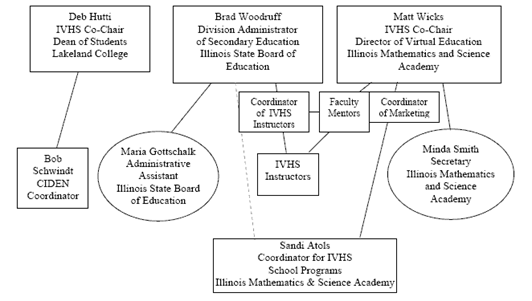
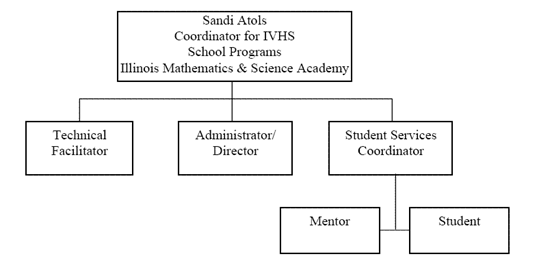
ORGANIZATIONAL CHART 1
ORGANIZATIONAL CHART 2